

AI Banking Malaysia: Build the Next-Generation Conversational Banking Experience
Digital banking is entering a new phase.
The next breakthrough is not another cleaner app menu, another dashboard, or another chatbot that only answers FAQs. The next banking experience is conversational, intelligent, and action-oriented.
Imagine a customer typing:
Send RM50 to Sarah for lunch.
Or uploading a bill and saying:
Pay this before Friday.
Or taking a photo of a dinner receipt and asking:
Split this with Amir, Mei Ling, and Daniel.
This is the future of AI banking: customers express intent in natural language, and the banking platform understands, validates, prepares, and executes the transaction securely with user confirmation.
Agmo helps banks, digital banks, fintechs, e-wallets, and financial institutions design and build AI-native banking experiences that turn everyday financial tasks into simple conversations.
Why AI Banking Matters Now
Most banking apps are still built around menu navigation. Customers need to know where to tap, which feature to open, which biller category to choose, and which reference number to copy.
AI changes that.
Instead of forcing users to follow the bank’s interface, the bank can now understand the user’s intent.
This creates a major opportunity for financial institutions to:
- reduce friction in money transfers and bill payments
- increase digital transaction adoption
- improve customer engagement and retention
- reduce call centre and branch dependency
- create a more inclusive banking experience for users who are not digitally fluent
- differentiate in a crowded financial services market
For CTOs and CIOs, this is not just a UX upgrade. It is a new interaction layer for banking.
What AI Banking Can Do
1) Natural Language Money Transfer
Customers can send money using normal language instead of navigating through multiple screens.
Example user prompts:
Send RM100 to Farah for dinner.
Transfer RM500 to my Maybank savings account.
Pay back Jason RM38 for Grab.
The AI banking assistant can understand the amount, recipient, payment purpose, account source, and transaction type. It then prepares the transfer and asks the user to review and confirm before execution.
This makes banking feel like messaging, while keeping the transaction flow controlled, validated, and secure.
2) Upload Receipt to Split Bill
Bill splitting is one of the most natural AI banking use cases.
A user uploads a restaurant receipt, and the AI assistant can:
- read the receipt
- identify total amount, tax, service charge, and items
- suggest equal or item-based splitting
- identify participants
- generate payment requests
- track who has paid and who has not
Example prompt:
Split this nasi lemak lunch receipt equally with Aisyah, Kumar, and Ben.
For younger customers, families, office groups, and social spenders, this becomes a high-frequency engagement feature inside the banking app.
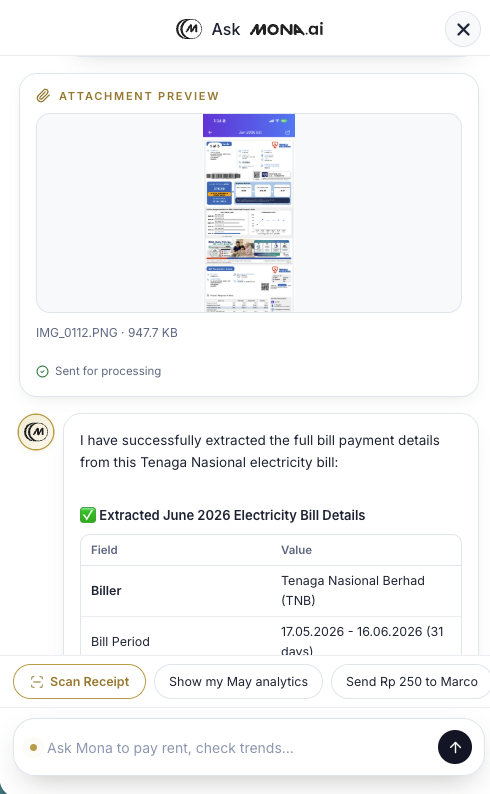
3) Upload Bill or Receipt, AI Detects the Biller
Paying bills is still too manual.
Customers often need to copy biller codes, account numbers, reference numbers, and amounts across PDFs, screenshots, emails, or paper bills.
With AI banking, the user simply uploads a bill.
The assistant can detect:
- biller name
- biller category
- customer account number
- reference number
- amount payable
- due date
- available payment method
Example prompt:
Pay this electricity bill from my main account.
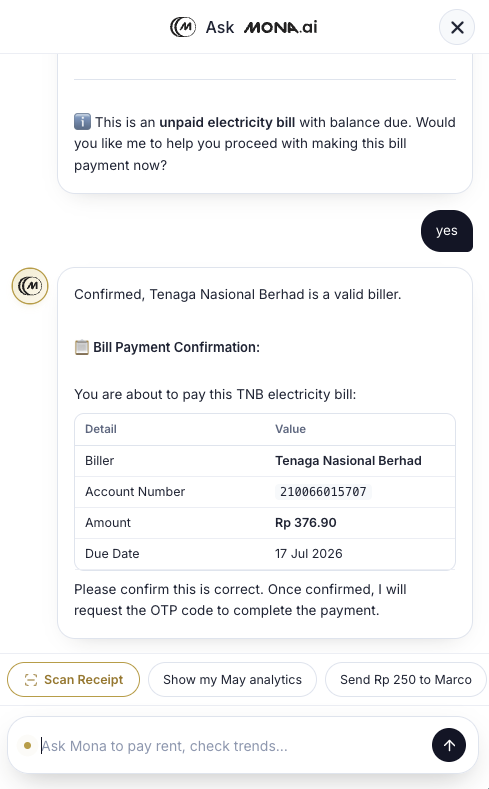
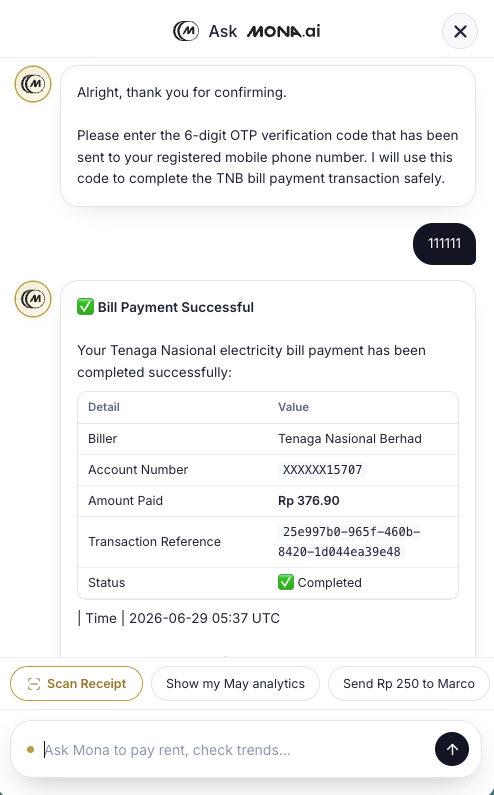
The AI assistant extracts the payment details, maps the biller, prepares the transaction, and presents a confirmation screen before payment.
This reduces user error, improves bill payment conversion, and makes digital banking more useful for everyday life.
4) Spending Insight Through Conversation
Instead of forcing users to read charts, AI banking lets users ask financial questions naturally.
Example prompts:
How much did I spend on food this month?
Show me my top 5 spending categories.
Why is my spending higher than last month?
How much did I pay for subscriptions this year?
The AI assistant can turn transaction history into plain-language insight, helping customers understand their money without manually filtering statements.
This is especially powerful for personal finance management, savings nudges, budget tracking, and financial literacy.
5) AI Banking Assistant for Product and FAQ Support
Customers often ask the same questions:
What is my transfer limit?
How do I increase my card limit?
Which account gives better savings returns?
What documents do I need for this application?
Instead of generic FAQ search, the AI assistant can retrieve answers from approved bank knowledge sources and provide guided explanations.
For banks, this reduces support load. For customers, it creates a more human, accessible banking experience.
6) AI-Assisted Payments, QR, DuitNow, JomPAY, and Beyond
The AI layer can sit above existing payment rails and banking services.
Potential integrations include:
- DuitNow transfer
- DuitNow QR
- JomPAY bill payment
- internal fund transfer
- card payment flows
- e-wallet top-up
- scheduled payments
- recurring payment setup
- merchant payment
- savings pocket movement
The key is not replacing the payment infrastructure. The key is creating an intelligent front layer that understands intent and orchestrates the correct banking workflow.
How Agmo Builds AI Banking Platforms
AI banking must be built differently from a normal chatbot.
A banking AI assistant cannot simply generate answers freely. It must be engineered with strong control, deterministic validation, and auditable transaction flow.
Agmo’s AI banking architecture typically includes the following layers.
1) Intent Understanding Layer
The assistant identifies what the customer is trying to do:
- send money
- pay bill
- split expense
- check spending
- ask product question
- manage account
- raise support request
- dispute transaction
- update instruction
This layer converts natural language into structured banking intent.
2) Document and Receipt Intelligence Layer
For uploaded receipts, bills, screenshots, or PDFs, the system extracts structured information such as:
- merchant name
- biller name
- invoice number
- account number
- reference number
- amount
- date
- line items
- tax and service charges
- due date
This enables bill payment, receipt splitting, reimbursement, claims, and transaction matching.
3) RAG Knowledge Layer
For FAQs, product rules, policies, interest rates, terms, and support content, the assistant should answer using approved bank knowledge only.
A Retrieval-Augmented Generation layer can be implemented so the AI retrieves from:
- bank product documents
- FAQ repositories
- SOPs
- customer support playbooks
- policy documents
- compliance-approved content
This improves consistency, reduces hallucination risk, and gives the bank better control over responses.
4) Payment Orchestration Layer
The AI assistant prepares the transaction but does not bypass banking controls.
The payment orchestration layer maps the user intent into the right workflow:
- transfer
- bill payment
- QR payment
- scheduled payment
- payment request
- internal fund movement
It validates mandatory fields, handles missing information, and prepares the transaction for confirmation.
5) Guardrails and Risk Control Layer
For banks, safety is non-negotiable.
The AI assistant must include controls such as:
- transaction limits
- prohibited requests
- suspicious instruction detection
- account ownership checks
- beneficiary validation
- high-risk transaction escalation
- step-up authentication
- confirmation before execution
- clear audit trails
The AI can assist. The deterministic banking system must still validate and approve.
6) Core Banking and Payment Integration Layer
Agmo can integrate the AI experience with the bank’s existing ecosystem:
- core banking
- customer profile system
- CASA accounts
- payment gateway
- DuitNow and JomPAY rails
- card management system
- fraud monitoring system
- CRM
- contact centre
- notification engine
- data warehouse
- mobile banking app
This ensures the AI banking experience is not a standalone gimmick, but part of the real banking stack.
7) Audit, Observability, and Compliance Layer
Every AI banking interaction should be traceable.
The platform should capture:
- user request
- detected intent
- extracted data
- knowledge sources retrieved
- tools called
- validation result
- confirmation step
- transaction outcome
- error or escalation reason
This gives CTO, CIO, risk, compliance, and audit teams the visibility needed to run AI safely in a regulated environment.
Sample AI Banking Use Cases to Build First
Pay by Text
Send RM80 to Daniel for dinner.
The assistant prepares a transfer and asks for confirmation.
Pay by Bill Upload
User uploads a TNB, water, telco, or assessment bill.
The assistant extracts details and prepares bill payment.
Split by Receipt
User uploads a receipt.
The assistant splits equally or by item and generates payment requests.
Ask Spending Questions
How much did I spend on petrol this month?
The assistant analyses transaction categories and gives a plain-language answer.
Smart Payment Reminder
Remind me to pay this bill 3 days before due date.
The assistant creates a reminder or scheduled workflow.
Product and Policy Assistant
What is the daily transfer limit for my account?
The assistant answers using approved bank documents.
Branch and Call Centre Deflection
The AI assistant answers common support questions and escalates complex cases to human agents.
Why CTOs and CIOs Should Act Now
AI banking is moving from novelty to customer expectation.
Banks that act early can build:
- a differentiated digital experience
- stronger customer engagement
- lower support cost
- higher transaction completion
- more inclusive digital banking
- reusable AI orchestration architecture
- stronger data-driven personalization
The winning banks will not simply add AI to the app. They will redesign banking around intent.
Why Work With Agmo
Agmo brings the full capability required to build AI banking platforms:
- mobile banking and digital product development
- AI assistant and RAG implementation
- document and receipt intelligence
- payment workflow integration
- enterprise backend engineering
- security and audit-aware architecture
- regulated industry delivery experience
- cloud, API, and integration engineering
We can support banks and fintechs through different engagement models:
- full outsourced delivery
- co-development with internal technology teams
- staff augmentation for AI, mobile, backend, and integration work
- proof-of-concept to production rollout
Whether you want to build a full AI-native banking experience or start with one focused use case, Agmo can help you design, implement, integrate, and scale it.
Start With a Practical AI Banking Pilot
The best way to start is not to rebuild the whole banking app.
Start with one high-frequency, low-risk, measurable workflow:
- natural-language money transfer
- upload bill to pay
- upload receipt to split bill
- spending insight assistant
- FAQ and product assistant
- payment reminder assistant
Within a pilot, we can define:
- user journey
- AI intent scope
- integration points
- data and security boundaries
- guardrails
- success metrics
- rollout plan
Call to Action
If you are planning the next generation of digital banking, now is the time to explore AI-native banking experiences.
Agmo can help you build a conversational banking layer that allows customers to send money, pay bills, split receipts, understand spending, and interact with banking services using natural language.
Talk to us to design your AI banking pilot.
Let’s turn your banking app from a menu-based interface into an intelligent financial assistant by writing to us at our contact form