

AI for General Elections: How Agmo Helps Build Voter Confidence With Data, AI, Digital Twin, and Digital Outreach
AI for Elections Is No Longer Optional. It Is Now Campaign Infrastructure.
General elections are no longer fought only through ceramah, banners, press coverage, and physical ground operations.
Today, voter perception is shaped continuously across TikTok, Meta, WhatsApp, online news portals, search engines, and community conversations. Political narratives can gain momentum within hours. Negative sentiment can spread before a campaign team has time to respond. Younger and undecided voters often form opinions from short-form videos, memes, influencer content, and algorithmically amplified news.
The challenge for political parties is no longer just communication.
The real challenge is this:
How do you deliver the right message to the right voters at the right time—while building trust, confidence, and measurable engagement?
Agmo helps political organisations, public-sector stakeholders, advocacy groups, and campaign teams build AI-powered election intelligence systems designed for modern voter engagement.
The goal is simple: use AI to build voters’ confidence. This is also the central objective highlighted in Agmo’s election AI strategy deck: applying AI not merely to automate outreach, but to strengthen voter confidence through better understanding, better timing, and more relevant communication.
Our election AI approach now includes two major civic technology platforms:
- UNDI.LA: Malaysia’s political pulse in real time, providing election intelligence, voter sentiment, candidate profiles, constituency insights, news intelligence and public-facing political data.
Explore here: https://undi.la/

- UndiBijak AI: an AI smart voting and candidate intelligence platform where voters can ask, understand, compare and vote wisely.
Explore here: https://undibijak.dahreply.ai/
Together, these platforms represent a new layer of civic AI infrastructure for Malaysia.
Why Traditional Political Campaigns Are Falling Behind
Many political campaigns still rely on outdated methods:
Generic messaging.
Manual content posting.
Reactive responses to negative news.
Disconnected social media, ground operation, and data teams.
Limited visibility into whether content is actually changing voter perception.
Agmo’s election AI strategy identifies three major gaps in current political campaigns: data blindness, the engagement trap, and technological stagnation. Data blindness happens when teams rely on incomplete or disconnected insights. The engagement trap happens when platforms reward shock-value content instead of constructive policy communication. Technological stagnation happens when campaign execution remains manual, fragmented, and disconnected.
In a modern election environment, this creates a serious disadvantage.
A campaign may be active online, but still not know:
Which voter groups are responding positively.
Which issues are gaining traction by locality.
Which narratives are becoming harmful.
Which content formats work best for young voters, families, first-time voters, or undecided voters.
Which messages should be amplified, adjusted, or retired.
This is where AI becomes a strategic advantage.
How Agmo Uses AI to Help in a General Election
Agmo’s approach combines data engineering, AI analytics, campaign intelligence, content targeting, sentiment monitoring, digital twin, and digital outreach infrastructure into one connected election technology ecosystem.
Instead of treating campaign communication as separate activities, Agmo helps teams build a unified AI-powered operating layer across media, social platforms, voter intelligence, AI-generated video communication, and outreach channels.
The result is a smarter campaign system that supports:
Voter intelligence dashboards.
Audience segmentation.
AI-assisted sentiment monitoring.
Narrative and misinformation detection.
Content opportunity discovery.
Targeted digital campaign planning.
AI digital avatar content generation.
Community-level outreach.
Performance measurement and continuous optimisation.
All systems should be designed around data governance, privacy, access control, consent management, and lawful data usage, using only approved data sources such as client-provided data, public signals, platform-permitted audience tools, media engagement data, survey data, and consent-based outreach lists.
1. Build a Privacy-Conscious Voter Intelligence Platform
The first step is turning fragmented campaign information into usable intelligence.
A Voter Intelligence Platform helps campaign teams understand audiences at the constituency, locality, and segment level without relying on guesswork.
Depending on the approved data sources available, the platform can bring together:
Publicly available demographic and geographic indicators.
Client-provided campaign data.
Survey and polling data.
Media engagement data.
Social listening signals.
Website and landing page analytics.
Consent-based supporter or volunteer lists.
Platform-permitted advertising audience insights.
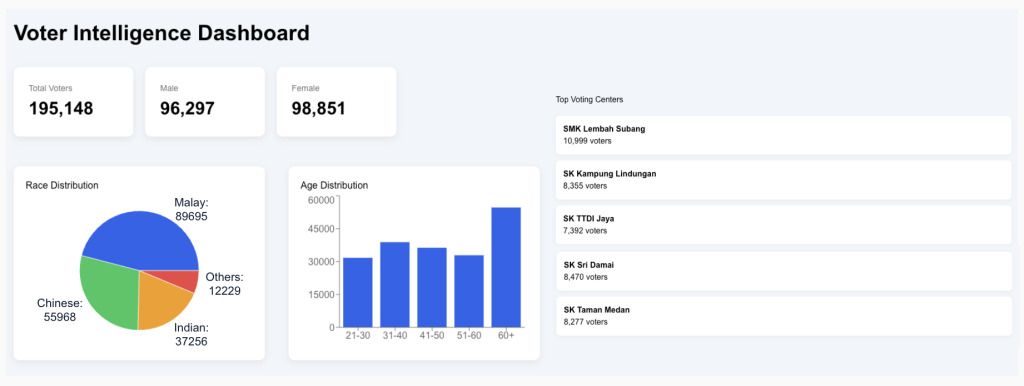
With the right governance framework, these inputs can be transformed into a dashboard that helps campaign teams understand voter concerns, content engagement, local priorities, and communication opportunities.
Agmo’s election AI strategy includes the concept of a voter intelligence dashboard that visualises campaign-relevant insights such as audience distribution, demographic patterns, locality-level priorities, and engagement opportunities.
Instead of asking, “What message should we push everywhere?”, teams can ask:
Which audience groups require more engagement?
Which localities are responding to which issues?
Which voter segments need clearer policy communication?
Which channels are generating meaningful engagement?
Which topics are building trust, and which are creating confusion?
This creates a stronger foundation for evidence-based campaign planning.
2. Segment Voters Into Meaningful Audiences
Modern election communication cannot rely on one-size-fits-all messaging.
Agmo’s proposed approach includes voter persona segmentation, such as:
Young urban professionals.
Middle-aged suburban families.
First-time voters.
Undecided voters.
Each group has different concerns, media habits, and expectations.
Young urban voters may care about jobs, cost of living, public transport, governance, climate, and the digital economy.
Suburban families may respond more strongly to education, healthcare, safety, housing, childcare, and local infrastructure.
First-time and undecided voters may need simpler issue explainers, trust-building content, and relatable proof points.
AI helps campaign teams identify these segments using approved and privacy-compliant inputs, analyse engagement behaviour, and recommend content themes that are more relevant to each audience.
The objective is not just targeting.
The objective is relevance.
When voters receive information that speaks to their real concerns, campaigns can build stronger trust and reduce communication fatigue.
3. Monitor Sentiment and Detect Narratives Early
Political narratives move fast.
A short video, misleading claim, viral comment thread, or negative article can quickly influence public perception. By the time a campaign team notices, the narrative may already have reached thousands or millions of voters.
Agmo’s AI strategy includes large-scale data collection and processing across social media content, public discussion signals, and multimedia content such as text, images, and video. This enables real-time monitoring, large-scale indexing, and structured analysis.
Using AI models, campaign teams can monitor:
Public sentiment.
Emerging voter concerns.
Viral narratives.
Misinformation themes.
Negative propaganda patterns.
Engagement intensity.
Comment sentiment.
Toxicity and amplification signals.
Agmo’s deck also shows how AI can analyse video and text comments using vision-language models and LLMs, scoring content by theme, intensity, sentiment, virality potential, agreement ratio, and engagement intensity.
This allows campaign teams to act earlier.
Instead of reacting after a harmful narrative becomes mainstream, teams can detect risk signals early and prepare a balanced, factual, and timely response.
4. Recommend the Next Best Campaign Action
Monitoring alone is not enough.
Campaign teams also need to know what to do next.
Agmo’s proposed AI system includes an LLM-powered recommendation layer that can support three major functions:
Intelligence dashboard
Track narratives, sentiment, engagement, and early warning signals.
Counter-narrative strategy
Identify harmful narratives, recommend response themes, suggest tone, and propose suitable audience segments.
Content opportunity discovery
Detect trending issues early, recommend campaign topics, and identify high-impact engagement moments.
This helps campaign teams move from manual guesswork to AI-assisted decision-making.
For example, when a local issue starts trending, the system can help recommend:
Whether to respond immediately or monitor further.
Which audience segment is most affected.
What content format may work best.
Which message angle should be used.
Which channel should be prioritised.
Whether the issue requires digital content, ground engagement, media placement, or community outreach.
This turns AI into a campaign command centre—not just a content generator.
5. Improve Digital Media Strategy With AI and Data
Traditional political advertising often feels too hard-sell, too broad, and too disconnected from voter interests.
Agmo’s election AI strategy contrasts the old media approach with a new AI and data-driven media approach: ensuring the right message reaches the right target audience without disrupting the user experience. One example given is prioritising positive or balanced coverage rather than relying only on time-based or view-count-based algorithms that may amplify negative news.
This is especially important for political communication.
Campaigns should not only chase impressions.
They should build confidence, credibility, and constructive visibility.
AI can help campaign teams identify:
Which articles should be promoted.
Which issues should be explained.
Which communities need more localised content.
Which content is likely to build trust.
Which messages are overexposed or underperforming.
For media partners and digital publishers, this can also support more relevant content delivery across online news platforms and social channels.
6. Support Targeted Outreach Across Meta, TikTok, WhatsApp, and News Platforms
Different voter groups consume content differently.
TikTok may influence younger voters.
Meta may be useful for broader demographic reach.
WhatsApp remains powerful for community-level sharing.
Online news portals help build legitimacy and reach politically attentive audiences.
Agmo’s strategy deck highlights how political parties globally use platforms such as Meta and TikTok for voter engagement, digital outreach, sentiment analysis, short-form content, influencer partnerships, real-time feedback, and younger voter engagement.
The deck also proposes a new AI and data-driven media approach that includes targeted campaigns, platform-permitted custom audiences, audience mapping, campaign score improvement, and community-level messaging.
For responsible deployment, Agmo can help design outreach systems with proper governance, consent management, compliance controls, platform policy alignment, and auditability.
This matters because election technology must not only be effective. It must also be trusted.
7. Use AI Digital Avatars to Scale Candidate Communication
In a general election, candidates and party leaders cannot physically attend every event, answer every voter question, or record personalised content for every community.
This is where AI digital avatars can help.
A digital avatar is an AI-generated virtual presenter that can deliver approved campaign messages in a natural video-based format. It can be used to explain policies, manifesto points, constituency updates, local initiatives, voter FAQs, and rapid responses across multiple languages and content formats.
For election campaigns, digital avatars can support:
Candidate-style video explainers.
Constituency-specific policy messages.
Multilingual voter education content.
Rapid response videos for emerging issues.
Short-form content for TikTok, Instagram Reels, Facebook, and YouTube Shorts.
WhatsApp-friendly video summaries.
FAQ-style videos answering common voter concerns.
The key advantage is speed and scale.
Instead of waiting for a full production crew, campaign teams can generate approved video content quickly from verified scripts. This allows political organisations to respond faster to public concerns, localise messages for different communities, and maintain a consistent tone across multiple digital channels.
For example, a campaign team can use digital avatars to explain:
What a policy means for young workers.
How a local infrastructure project benefits residents.
What support is available for small businesses.
How a candidate plans to address traffic, housing, healthcare, or education issues.
Why a viral claim may be inaccurate, with a calm and factual explanation.
Digital avatars are especially useful for reaching younger and mobile-first voters, who are more likely to engage with short-form video content than long written statements.
However, election use must be responsible.
Agmo can help design digital avatar workflows with proper governance, including:
Approved scripts before generation.
Clear disclosure that content is AI-generated where required.
Candidate or party consent before avatar usage.
Brand and tone guidelines.
Fact-checking before publication.
Audit logs of generated content.
Human review before release.
Used correctly, digital avatars do not replace candidates. They help candidates and campaign teams communicate more consistently, more locally, and more frequently—especially during fast-moving election periods.
The outcome is a scalable communication engine that helps voters receive timely, clear, and relevant information in the video formats they already consume.
8. Enable Hyperlocal Community Engagement
Elections are national events, but voter trust is often built locally.
A voter may care less about a national manifesto headline and more about:
A road upgrade in their area.
A school issue near their home.
A local healthcare facility.
Flood response.
Public transport access.
Cost-of-living support in their community.
The performance of their local representative.
Agmo’s election AI deck identifies community-level messaging as a way to deliver hyperlocal, real-time updates, highlighting local initiatives and achievements while helping counter misinformation at neighbourhood level.
This is where AI can help campaign teams localise content quickly.
Instead of sending the same message nationwide, teams can prepare constituency-specific updates, community-level FAQs, local achievement summaries, digital avatar explainers, and rapid responses to misinformation.
The benefit is stronger grassroots trust.
9. Create a Long-Term AI-Driven Election Strategy
AI should not only be used during the official campaign period.
The strongest political organisations will build continuous voter engagement systems long before election day.
Agmo’s AI-driven data strategy plan separates election AI maturity into near-term, mid-term, and long-term phases. The near-term plan includes building voter data segments, launching targeted campaigns, delivering relevant content, and starting A/B testing. The mid-term plan includes enhanced voter profiling, dynamic content targeting, multi-platform expansion, and AI sentiment monitoring. The long-term plan includes a comprehensive voter intelligence platform, AI-driven content recommendation, continuous engagement, and predictive analytics to anticipate voter concerns and narratives.
This roadmap gives campaign teams a practical way to start small and scale responsibly.
A political organisation does not need to build everything at once.
It can begin with a pilot constituency, one media channel, one digital avatar content workflow, or one voter segment—then expand into a full campaign intelligence platform.
What Agmo Can Build for General Election Campaigns
Agmo can support election-related AI and data initiatives across several practical modules.
Voter Intelligence Dashboard
A central dashboard for campaign teams to understand audience segments, locality-level priorities, demographic patterns, content engagement, and outreach opportunities.
AI Sentiment Monitoring
A real-time monitoring system to track narratives, public sentiment, engagement signals, and emerging issues across social platforms and online discussions.
Narrative and Misinformation Detection
AI-assisted detection of harmful narratives, misleading claims, coordinated amplification, and high-risk viral content.
Campaign Content Recommendation Engine
A recommendation layer that suggests content themes, response strategies, audience segments, timing, and channel selection.
AI Digital Avatar Content Engine
A governed digital avatar system that converts approved campaign scripts into multilingual video explainers, candidate-style messages, FAQ responses, local updates, and short-form social content for platforms such as TikTok, Meta, YouTube Shorts, and WhatsApp.
Persona-Based Campaign Planning
Audience segmentation for groups such as young urban professionals, suburban families, first-time voters, and undecided voters.
Media and Publisher Activation
AI-assisted selection of articles, news placements, and balanced content amplification through relevant media channels.
Community Outreach System
Structured, localised, and consent-based communication for community-level updates, issue explainers, digital avatar videos, and voter engagement.
Campaign Analytics and A/B Testing
Measurement of content performance, click-through rate, engagement quality, sentiment shift, and message resonance.
Why Agmo
Agmo Group is one of Malaysia’s leading homegrown technology companies, with deep experience in AI, data platforms, mobile applications, web systems, enterprise integration, and mission-critical digital solutions.
For election-related AI systems, technical capability alone is not enough.
Campaign technology requires:
Secure data handling.
Reliable infrastructure.
Strong governance.
Transparent audit trails.
Scalable dashboards.
Integration with media and outreach platforms.
Fast iteration during high-pressure campaign periods.
Responsible AI-generated content workflows.
Local understanding of Malaysia’s political, linguistic, and demographic context.
Agmo brings the engineering depth, AI capability, and local execution experience needed to support complex election technology programmes.
Targeted Outcomes
With the right AI and data foundation, political organisations can achieve stronger outcomes across communication, voter engagement, and campaign strategy.
Agmo’s election AI strategy identifies several key outcomes, including delivering the right message to the right audience at the right time, strengthening constructive narrative visibility, reducing negative news-cycle amplification, building public trust and confidence, improving insight into voter sentiment, strengthening digital influence, engaging younger and undecided voters, and improving personalised content delivery.
In simple terms, AI helps campaign teams become:
More informed.
More responsive.
More relevant.
More localised.
More trusted.
More measurable.
More consistent in video-based communication.
Start With a Practical Election AI Pilot
The best way to begin is not by building a massive platform immediately.
The best way is to start with a focused pilot.
Agmo can help define:
The first constituency, geography, or audience segment to analyse.
The approved data sources and governance requirements.
The first dashboard use case.
The initial sentiment monitoring scope.
The priority campaign channels.
The first digital avatar content workflow.
The content testing plan.
The compliance and audit framework.
The roadmap from pilot to full election operations.
A practical first phase could include:
One voter intelligence dashboard.
One AI sentiment monitoring module.
One campaign content recommendation workflow.
One digital avatar video content workflow.
One targeted media or community outreach pilot.
One reporting dashboard for campaign performance.
From there, Agmo can scale the solution into a full AI-powered election intelligence platform.
Call to Action
If your organisation is preparing for a general election, now is the time to move beyond manual campaign operations and fragmented digital outreach.
Agmo can help you design and deploy an AI-powered election intelligence system that supports voter confidence, narrative monitoring, targeted communication, AI digital avatar content, and measurable campaign engagement.
Speak to Agmo to explore an Election AI Discovery Workshop.
In the workshop, we will help define:
Your priority voter segments.
Your approved data sources.
Your first 2–3 campaign intelligence use cases.
Your media, Meta, TikTok, WhatsApp, digital avatar, and publisher activation strategy.
Your AI sentiment monitoring and misinformation detection approach.
Your roadmap from pilot dashboard to full election command centre.
Build voter confidence with AI, data, digital avatars, and responsible digital engagement.
Contact us at our contact form